
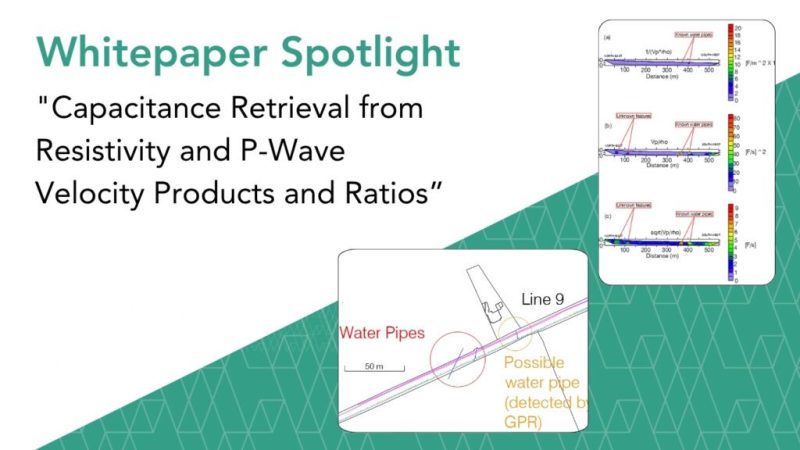
We are proud to release a whitepaper on “Capacitance Retrieval from Resistivity and P-Wave Velocity Products and Ratios“ co-written and driven by the innovative minds of Romaric Limacher, Sophie Mann and Antoine Misse from our Subsurface Engineering department in Ireland.
The whitepaper will be featured in First Break, the leading publication in Europe serving the geoscience and engineering community – focusing on exploration, production, and technological advancements to keep industry professionals informed and connected.
At Murphy Geospatial, our integrated approach to subsurface investigations drives innovation. This newly published whitepaper highlights how our geophysics team, embedded within the Subsurface Engineering Department, leverages full access to utility survey data to push the boundaries of near-surface geophysics.
The Challenge
Ineffective communication across separate company departments can lead to conclusions being drawn based on incomplete datasets. This makes it difficult to validate interpretations and slows innovation. At Murphy Geospatial, Our geophysicists are fully integrated within multidisciplinary utility survey teams, giving us access to rich datasets—leading to a surprising discovery.
Our Breakthrough
By combining two types of geophysical data—seismic wave speed (P-wave velocity) and electrical resistivity—our team developed a new method to highlight buried water-related features. The results were consistent across different sites and geological conditions.
What We Can Now Detect
- Water pipes and culverts
- Groundwater (requires further research and confirmation)
- Potential sinkholes or voids (requires further research and confirmation)
What Gets Filtered Out
- Other utilities like telecom cables
- Geological layers not related to water
Why It Matters
- New Detection Capabilities: This method opens new possibilities for identifying karst features, sinkholes, and voids—critical for infrastructure planning and risk mitigation.
- Scientific Innovation: The paper introduces a novel physical model linking seismic and resistivity data to Poisson’s ratio and resistance derivatives, potentially offering a new way to interpret subsurface mechanical properties (requires further research and confirmation).
- Operational Advantage: Our integrated team structure made this discovery possible—something not easily replicated by competitors without similar access to utility data.
Next Steps
The findings suggest exciting potential for:
- Estimating Poisson’s ratio from combined datasets
- Enhancing groundwater and void detection
- Improving geophysical interpretation workflows
Further research and publications will be essential to confirm or refine these findings.
View the full whitepaper here: https://www.firstbreak.org/ (Page 35)
Find our more about our Subsurface services here.