
What is Asset Performance Monitoring?
Asset performance monitoring is a proactive strategy for managing built assets using advanced Internet of Things (IoT) sensors. This approach provides continuous oversight, integrating various monitoring solutions into a custom maintenance plan.
Asset performance monitoring focuses on addressing potential issues before they escalate into significant problems, rather than reacting to them after they occur. It aims to prevent unnecessary downtime, maximise asset performance, enhance operational efficiency, and extend asset longevity. Data-driven insights from asset performance monitoring enable stakeholders to make informed decisions, optimising maintenance schedules and resource allocation.

How does Asset Performance Monitoring work?
Asset performance monitoring works by using IoT sensors and other advanced technologies to continuously monitor the condition and performance of assets. These sensors collect data on various parameters such as temperature, vibration, pressure, and more. The collected data is then analysed in real-time to detect anomalies or trends that indicate potential issues. This analysis helps in identifying maintenance needs before problems arise.
By integrating continuous monitoring with custom maintenance plans, asset performance monitoring ensures that maintenance activities are performed proactively, targeting specific areas that need attention. This approach not only prevents unexpected failures but also optimises the maintenance process, reducing costs and downtime.
Projects and sectors we support with Asset Performance Monitoring:
- Construction
- Infrastructure development
- Industrial and manufacturing facilities
- Commercial buildings
Read more about the integration of IoT sensors in manufacturing facilities by our Head of Manufacturing, JP Kelly.
How Murphy Geospatial's "Precision from Space" revolutionises our monitoring solutions
Murphy Geospatial’s “Precision from Space” or InSAR Satellite Monitoring approach integrate advanced monitoring satellite technologies like InSAR and GNSS with the expertise and capability to enhance results with terrestrial technologies as automated scanning and ground-based IoT sensors to ensure that every insight is accurate, relevant, and tailored to the project needs. Empowering you to focus solely on outcomes, with Murphy Geospatial, data isn’t just collected, it’s transformed into intelligence you can trust.
Examples of Asset Performance Monitoring
Industrial Machinery Monitoring_
Sensors installed on machinery to monitor temperature, vibration, and operational efficiency, with data analysed to predict when parts might fail or require maintenance.
Building Infrastructure_
Monitoring HVAC systems, electrical systems, and structural integrity in commercial buildings, with data used to optimise energy consumption and schedule maintenance activities.
What are the benefits of Asset Performance Monitoring?
Address issues early to prevent significant problems and reduce unexpected downtime and repair costs.
Maximise asset performance and optimise maintenance schedules and resource allocation.
Prolong asset lifespan and maintain functionality and efficiency over time. Read more about Maximising Asset Longevity with Asset Performance Monitoring here.
Lower maintenance costs by preventing major failures and minimising operational disruptions.
Identify and mitigate safety risks through continuous monitoring, ensuring safe operation of critical infrastructure and machinery.
CASE STUDY
Cherry Park DLR Monitoring - East London, UK
The Cherry Park development comprises of seven residential buildings, a Retail Box, and a basement, with structures up to 38 storeys. The project required the installation, commissioning, and maintenance of an autonomous structural monitoring system to ensure safety and compliance with Transport for London standards.
The monitoring system, covering affected assets such as the DLR train network and Woolwich Tunnel Enclosure, required a 90-day baseline data period before construction could begin. Murphy Geospatial installed the system within 10 shifts, using various geodetic survey prisms and total stations, with data accessible via an online portal. The monitoring included real-time calculations and fortnightly reports, ensuring geospatial certainty and immediate notifications for any critical events.
Key services provided:
- Installation and commissioning of an autonomous structural monitoring system.
- Real-time data monitoring and analysis through an online web portal.
- Use of total stations and geodetic survey prisms for precise measurements.
- Photographic condition assessment.


CASE STUDY
Luas Line - Dublin, Ireland
Murphy Geospatial undertook a project to develop and implement a non-invasive continuous monitoring system for an embedded light rail track during bulk excavation and ground anchor installation. The system utilised three fully automatic AMS monitoring systems alongside vibration monitors, inclinometers, and precise level observations to monitor track settlement, vibration levels, and pile wall deformation caused by excavation and anchor destressing.
Key services provided:
Continuous monitoring of over 800m of light rail track without the need for traditional monitoring targets or prisms.
Monitoring and reporting of track settlement and adherence to safety limits
Monitoring and alarming on vibration levels
Surveillance of pile wall deformation throughout the project duration.
Direct engagement with Transport Infrastructure Ireland to ensure data reliability and communication of results to all stakeholders.
CASE STUDY
Bridge and Viaduct Monitoring, UK
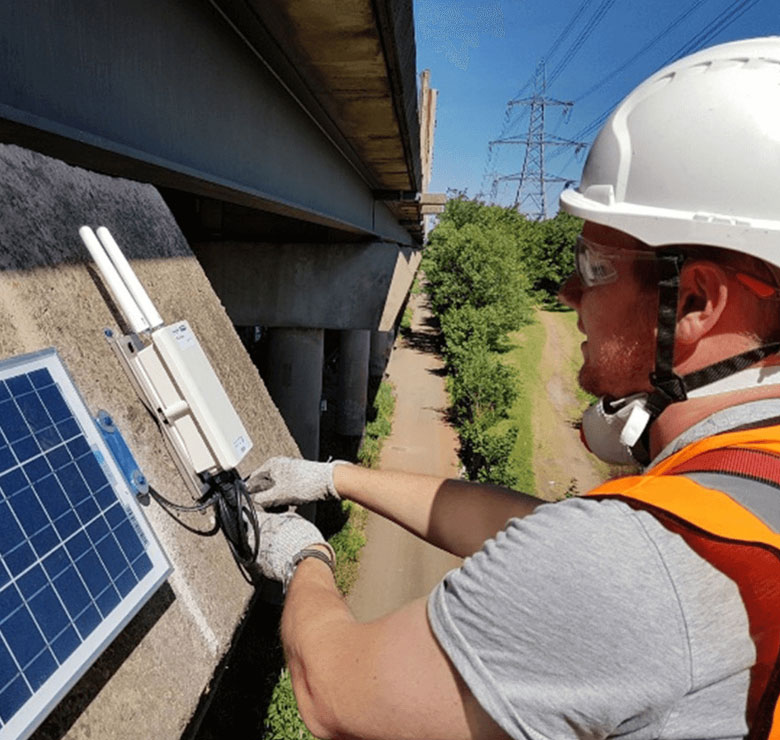
Murphy Geospatial implemented a comprehensive automated monitoring system for a viaduct carrying a motorway, involving over 2500 wireless sensors and various geotechnical instruments. Our team managed site logistics, safety, and health protocols throughout the 6-month installation period, addressing challenges like changing ground conditions, harsh weather, and safety risks due to complex site conditions. The project’s success was underscored by real-time data transmission to a cloud-based visualisation platform, enabling continuous monitoring and reporting of structural integrity.
Key services provided:
- Installation of 2500+ wireless sensors and geotechnical instruments
- Installed a comprehensive monitoring system comprising 16 automated total stations, 3 GNSS stations, 1300 vibrating wire strain gauges, 250 bi-axial tilt sensors, 1000 linear displacement sensors, 12 piezometers, 17 extensometers, and 9 inclinometers
- Comprehensive site management including logistics, safety, and health protocols.
GET IN TOUCH
Got a question? Speak to our team today.
For more information on how we manage your data, please see our privacy policy