
Our
projects
PROJECT
Bridge Monitoring – From Limerick to Offaly, Ireland
Client
> Siemens Energy Limited
Sector/Market
> Infrastructure
Services
> Monitoring – Structural Health
Location
> Limerick to Offaly, Ireland
Project summary
Siemens Energy Ltd approached Murphy Geospatial to format a proposal or a monitoring plan and solution to measure the impact of the passage of an exceptionally heavy vehicle on several road bridges. The trailer itself is 27m long and weighs 48.5 Tonnes empty. The flywheel weighs 187 Tonnes, and the Generator weighs 202 Tonnes.
The brief
The bridges to be monitored have been selected after a technical assessment of all bridges on the designed path.
The aim of the monitoring solution, for each bridge, is to measure any movement and subsequent stresses caused by the dynamic abnormal load and to verify if any permanent deformations.
The challenges
The main challenge was to find a monitoring solution that satisfied all parties and ensured that the bridges to be crossed were not structurally affected.
The other challenges included dynamic and ongoing interpretations of new state processes, long nightshifts, planning on site in real time and while in coordination with the other parties involved in the transportation.
Our work
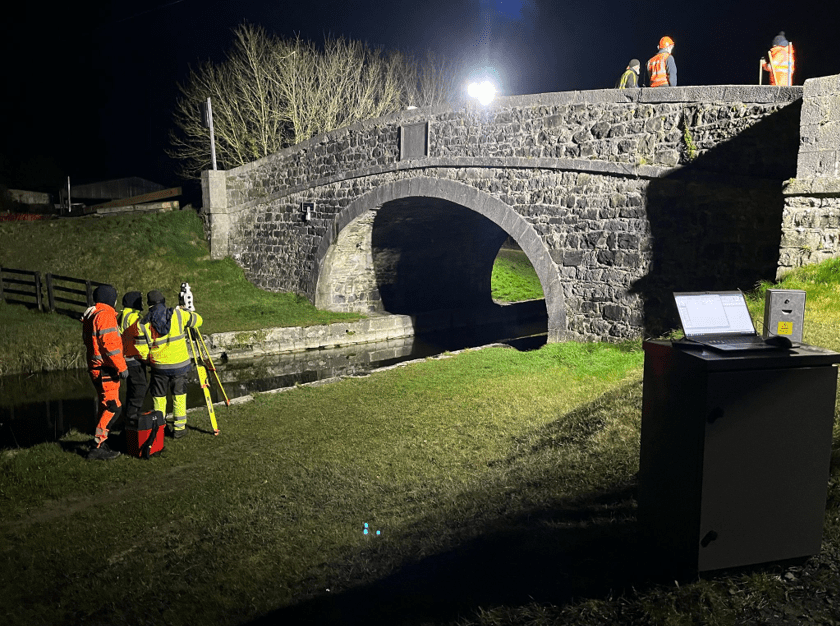
Bridge deflection under abnormal stress conditions (truck passage). In order to monitor the live deflections and displacements induced to the structures during the passage of the abnormal load, a solution based a number of robotic total stations and targets will be deployed. Each robotic total station will be locked whilst tracking the coordinates of a target prism, installed on the structure.
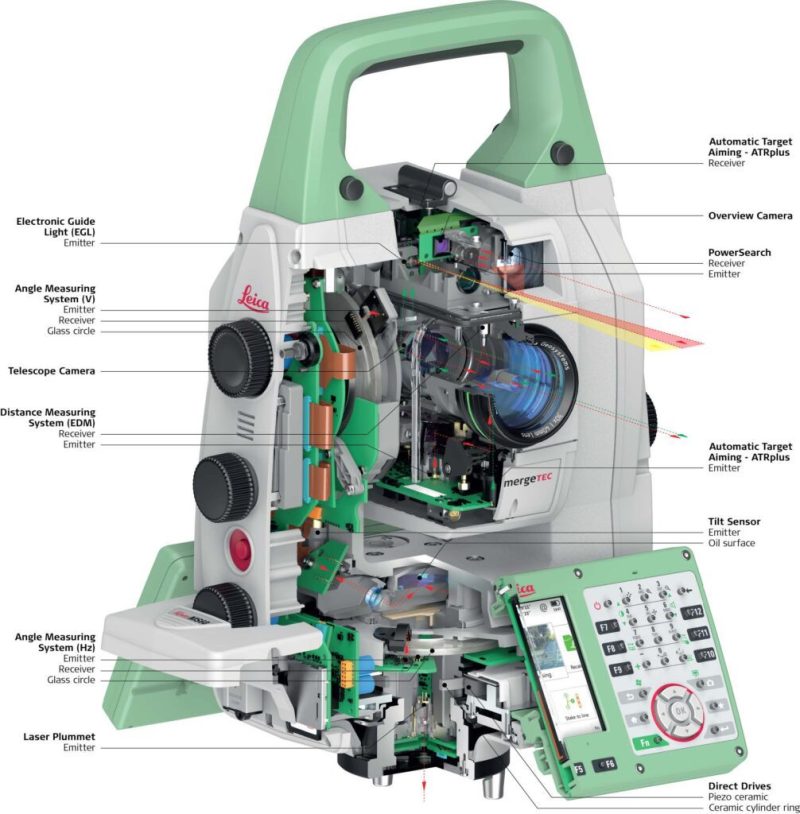
High accuracy monitoring prisms will be used as targets. The coordinates will be recorded and streamed at 1Hz frequency to a locally connected workstation ready to be analysed, visualised and shared only minutes after the passage. An operator will be attending each set up during the passage of the abnormal load.

Additionally, a levelling profiling survey will be conducted before and after each transport event to establish a detailed deformation baseline and detect any permanent structural changes. This dual-phase monitoring approach enhances accuracy in deformation analysis, providing a comprehensive evaluation of both immediate and residual impacts on the bridge’s structural integrity.
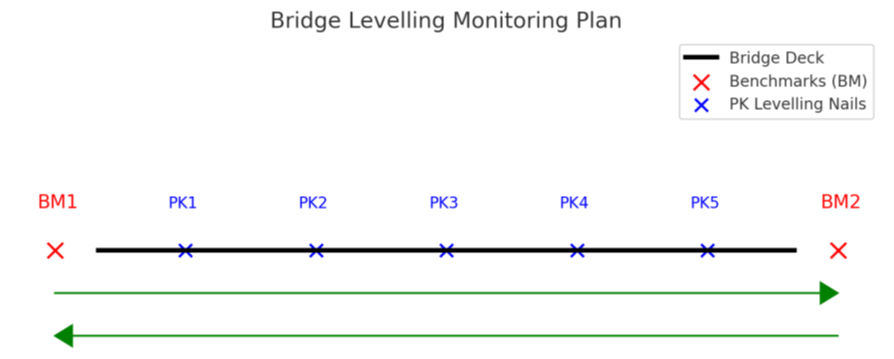
The methodology to be followed is straightforward for this bridge. Two benchmarks will be installed beyond each end of the bridge, outside the zone of influence, to provide stable reference points for detecting any permanent deformations in the structure.
A double levelling run will be carried out before and after the abnormal load passage. The levelling route will include levelling nails on the tarmac, placed at 10–20m intervals along the bridge next to the hard shoulder. These nails will maximise accuracy, as they will serve not only as monitoring points but also as change points.
This methodology creates relative height distances that can be repeated at any time, allowing for a denser comparison of changes over shorter distances without relying solely on the benchmarks. Below is a sketch of the levelling run.
Our team
Murphy Geospatial assembled a team of surveyors from across the company, leveraging expertise from various departments.
Results
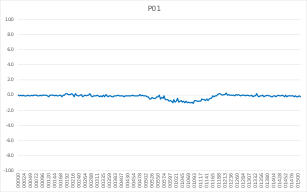
Results from the truck passage showed minimal movement across all bridges monitored. A sample of the results can be observed in the graph below.
Client Testimonial
“Siemens Energy contracted Murphy Geospatial as our monitoring partners (required by RW18 Process) for the delivery and they proved to be a perfect addition to our team. The Murphy scope involved the development of the monitoring proposal and incorporated live monitoring, crack monitoring, strain gauges and levelling runs. We found the Murphy team to be hardworking, dedicated, knowledgeable, experienced and most importantly “patient” during the several iterations of the process that we all endured.”
Stephen Reilly
Siemens Energy Ltd.
Contact
For more information on this project, please email info@murphygs.ie or call us on +353 (0)1 690 9799