
Our
projects_

PROJECT
BAFTA, 195 Piccadilly, London, UK
Client
> Knight Harwood
Sector/Market
> Property
Services
> Monitoring – Environmental
Location
> Piccadilly, London
Project summary
Murphy Geospatial was delighted to be involved in the regeneration of BAFTA’s iconic London headquarters in Piccadilly. The project involves a comprehensive refurbishment and expansion of this Grade II listed building to create a flexible and state of the art space. The scheme includes a top floor extension to create a new members’ area which requires the raising and re-integration of two large Victorian rooflights and decorative plasterwork. The new design of the rooftop spaces will showcase these listed rooflights which have been concealed for 40 years. This aspect of the refurbishment will reinstate the original design of the 1883 galleries of the Royal Institute of Painters in Water Colours.
The brief
Murphy Geospatial was appointed by Knight Harwood to provide environmental monitoring solutions at BAFTA, 195 Piccadilly during site demolition and construction works, to mitigate any risks around the project.
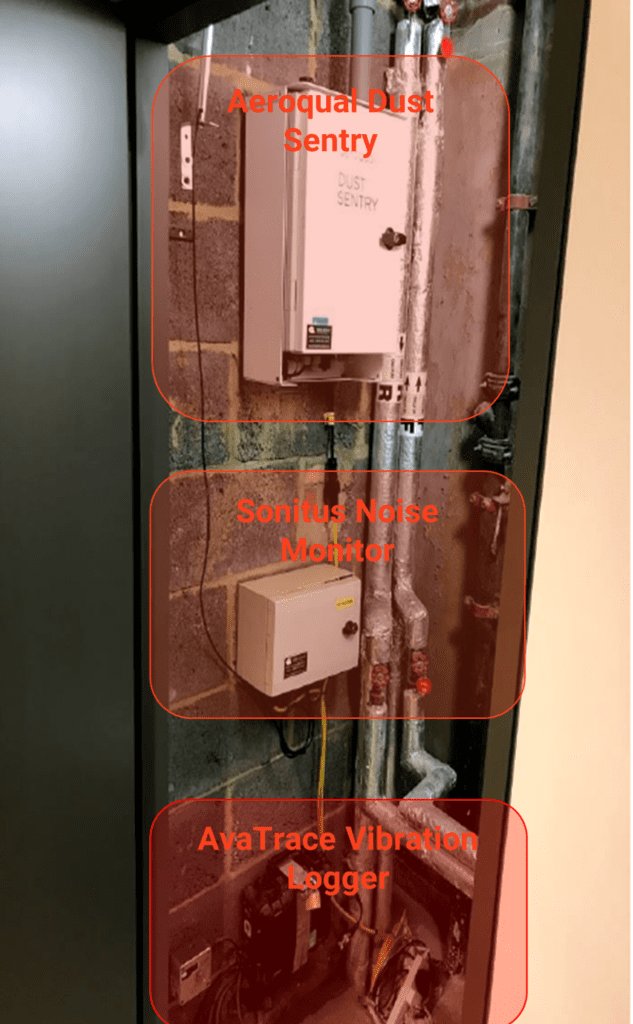
Vibration units were installed to measure Peak Particle Velocity (PPV) of the building at specific locations.
Noise units were installed to measure the average sound level in each measurement period in decibel (dB).
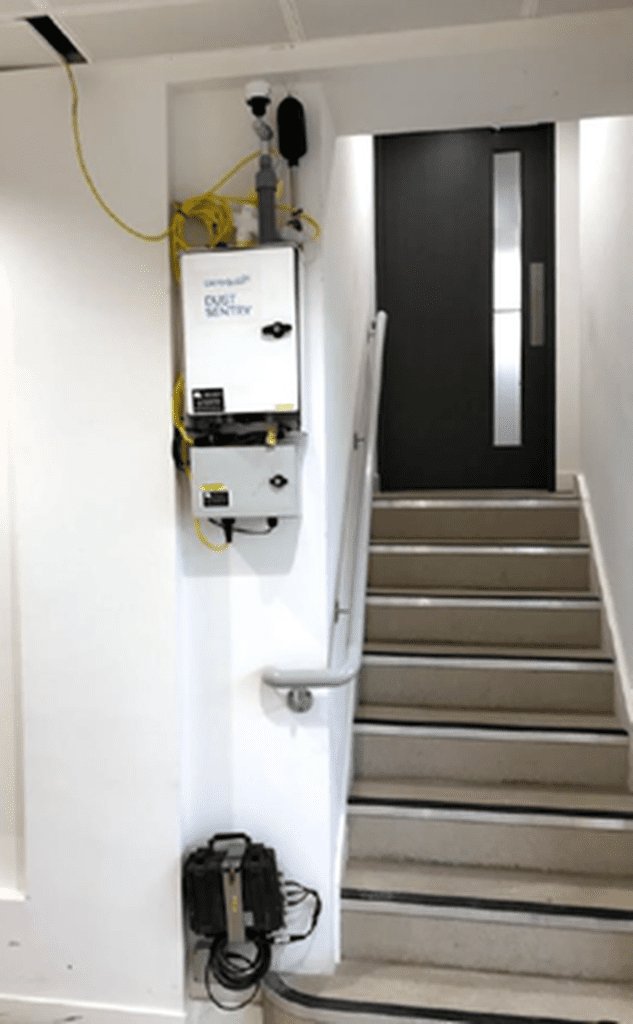
Dust units were installed at the 1st and 4th level to record PM10 concentrations of the air quality in µg/m3 over contiguous 15-minute intervals.
The challenges
The trigger levels had to be revised several times as per client’s request. Furthermore, we faced challenges during the project which affected the monitoring as there was power disconnection on site, water ingress and complaints from tenants close to the site. Apart from that, there were trigger alerts from external sources and non-site related works but we managed to efficiently overcome and deliver the works accordingly.
Our work
Early engagement was key to understand exactly what the client required. A site visit beforehand, followed by a detailed discussion and a full review of the specifications were critical.
Careful planning was required to execute the site works. Regular communications with the client was vital to ensure that everyone was kept up-to-date with the progress. Access to the site for the installation of monitoring equipment was carefully coordinated and arranged with the client’s permission, considering the sensitive nature of the project.
The site visits were mainly for maintenance purposes, of the units – once per 40 days on average.
The works were executed within the allotted time frame with an agreed staged installation of the monitoring.
The following was delivered to the client:
(1) The installation of 2no. AvaTrace M80 Tri axial sensors for vibration monitoring.
(2) The installation of 2no. Aeroqual Dust Sentry Monitors for dust monitoring.
(3) The installation of 2no. SON EM2010 Sound Level Monitors for noise monitoring.
Data collected for the baseline monitoring period will be treated as the baseline data (background monitoring) where the common trend can be observed before any work is carried out within the zone of influence.
Real-time data are recorded automatically 24/7. Trigger alerts have been set for each unit as per client’s specification in combination with the background monitoring.
Our team
Our assigned project manager Vada Charitsi engaged with the client early in the project lifecycle (prior to starting on-site works) to ensure that the placement of the environmental sensors would not hinder the operations of the adjacent in-use building and the construction works on the site itself. The installation was undertaken by our expert field technicians. On-going management of the data collected progressed as planned. Our field teams attended the site regularly to relocate units and undertake general maintenance such as filter swaps and battery changes for the vibration monitors.
Results
The regeneration project was completed successfully and the client was happy with the weekly deliveries – during the site demolition and construction works. Moreover, extra daily reports were issued to be presented in meetings with the client’s sub-contractors.
Whilst the monitoring was not without trigger breaches, the client delivered their project with minimal disruptions in relation to the measured/monitored parameters (i.e. noise, dust, vibration).
Contact
For more information on this project, please contact our UK Monitoring team by emailing info@murphygs.com or call us on +44 (0)192 362 4800